

CISCO Cohesion
From hot mess to high standards: How a Design System Transformed Engineering Culture
In an environment where engineering reigned supreme (the Enterprise Networking business unit at networking giant Cisco Systems) and design was often an afterthought, I led the charge to introduce a unified design system that delivered real, scalable value.
By grounding the system in performance, consistency, and code-friendly patterns, I was able to shift perceptions and win trust across the org (particularly Engineering).
What started as a grassroots effort quickly became an essential foundation for product velocity and quality. This is the story of how design earned its seat at the table—on engineering terms.
Some Basics
Team Size: 78
Geographies: 3 (India, US, Ukraine)
Disciplines led: 4 - Design, Research, Design Thinking & Design Ops
Budget Managed: $7M+
Key Metrics
-
Saved the company $4M in 1 year by cutting redundant design & development work.
-
Delivered 1 unified design system that included page grids, motion graphics/interactions, illustration library, component system covering everything from buttons to 6 different data tables in 6 months.
-
Improved designer and developer efficiency by 24% in 6 months.
-
Scaled Cohesion, the design system across 5 major product lines in 1.5 years.
Leadership Challenge
Context
-
Introduced a design system into a deeply engineering-driven culture, challenging long-held norms and shifting perceptions of design as merely visual polish.
-
Navigated resistance from engineering teams that prioritized speed, maintained strict code ownership, and lacked exposure to the strategic value of cohesive UX.
-
Identified the absence of a shared design language and clear ROI as key barriers to adoption—building the case for a scalable system that enabled consistency, efficiency, and cross-team alignment.
Approach
-
Positioned the design system as an engineering accelerator—highlighting faster build times, reduced tech debt, and fewer UX bugs.
-
Co-created components with engineering leads to ensure shared ownership, utility, and adoption across teams.
-
Used storytelling, hands-on demos, and quick wins to show how consistency could scale quality and impact—transforming skepticism into strong support.
-
Framed the system as critical infrastructure, not just a design tool, securing buy-in and cross-functional alignment.
Outcome
& Impact
-
Delivered a scalable design system that transformed collaboration between design and engineering across the product ecosystem.
-
Built a comprehensive system with editorial standards, flexible UI guidelines, an illustrated component library, and extensible coded components.
-
What started as a proof of value became the foundation for a shared design language—enabling faster, more consistent, and confident product delivery.
The System
Components
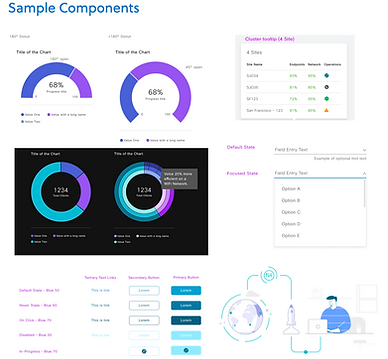
This gallery gives you a view into the extensive library of components in the Cohesion Design System. Cohesion lived for many years after I left Cisco, having been retired in 2023.


DNA Center was designed with rich, interactive data visualizations to help users troubleshoot and trace data flow. These silent videos are meant to showcase the UI in action—not to be narrated.
Cohesion Motion Graphic Designs


1. Traffic Flows_Sankey.mp4

2. Unassigned Endpoints Flow.mp4

DNAC-Cloud-home-loading-animation-1.mov
Cohesion
Design Principles
Intelligent
Simplify tasks and translate data into vital insights. Present information in context.
Empowering
Instill trust by responding to change and clarifying priorities. Set clear expectations to enable people to act with confidence.
Unified
Create seamless end-to-end experiences. Design for consistency to build trust, familiarity and efficiency.
Elegant
Rigorously balance complexity with necessity. Craft clear language, purposeful graphics, focused visualizations and memorable workflows.